


Macaron Tower Estimator
Plan your perfect 10-tier (or any tier) macaron tower. Select your structure method to see estimated counts, batch requirements, and safety buffers.
Enter your specifications and click Calculate to see how many macarons you need to bake.
You are standing in your kitchen, staring at a stack of empty cake boxes and a bag of almond flour. The client wants a macaron tower that reaches the ceiling-well, maybe just ten tiers high. It looks stunning on Pinterest, but now you have to bake them. And here is the brutal truth: guessing the number will either leave you with three hundred leftover shells or a sad, sparse structure that collapses under its own weight.
Calculating the volume of a conical shape isn't rocket science, but it requires accounting for structural integrity, not just geometry. A standard macaron is roughly 4 cm in diameter and 2 cm thick. When stacked in a pyramid or cone, they don't pack like cubes; they nestle into each other's gaps. For a 10-tier tower, we aren't looking at a simple multiplication problem. We are looking at a logistical challenge involving density, stability, and the inevitable breakage rate.
The Geometry of Sweetness
Most commercial macaron towers are built as cones or pyramids. Let’s assume a classic conical shape because it’s the most stable and visually appealing for events. To figure out how many fit, we need to look at the dimensions. A typical professional macaron tower base has a diameter of about 30-35 cm (12-14 inches). Each subsequent tier shrinks by about 2-3 cm in diameter to maintain the slope.
If you were to treat this as a pure math problem using the formula for the volume of a cone ($V = \frac{1}{3}\pi r^2 h$), you would overestimate the count. Why? Because macarons are irregular solids. They have feet (the ruffled edges), domes, and filling gaps. You cannot fill 100% of the space. In packing theory, spheres only fill about 74% of available space when packed tightly. Macarons are worse-they’re squishy and uneven. A realistic packing efficiency for a hand-built macaron tower is closer to 60-65%.
Let’s run the numbers for a standard 10-tier setup:
- Tier Height: Approximately 30-35 cm total height.
- Base Diameter: 32 cm.
- Top Diameter: ~8 cm.
- Macaron Size: Standard 4 cm diameter.
Using a conservative estimate based on layer-by-layer calculation (rather than pure volume), a solid cone of this size typically holds between 350 and 450 macarons. But wait-you rarely build a solid block of macarons. Most towers use a central core (styrofoam or cardboard) to save money and weight. This changes everything.
Solid vs. Hollow: The Core Difference
This is where beginners get burned. If you try to make a completely solid tower of 10 tiers, you are baking nearly half a kilogram of almond flour per batch, and you might need 10-12 batches. That is days of work. Plus, the bottom macarons will crush under the weight of the ones above them if not supported properly.
Professional bakers almost always use a hollow core. Here is how the math shifts:
| Tower Type | Structure Method | Approximate Count | Best For |
|---|---|---|---|
| Solid Cone | No internal support; fully packed | 380 - 450 | Small displays, heavy bases |
| Hollow Core | Styrofoam/cone insert + outer shell | 220 - 280 | Weddings, large events, cost-saving |
| Tiered Stand | Separate plates per tier | 150 - 200 | Easy transport, modular setups |
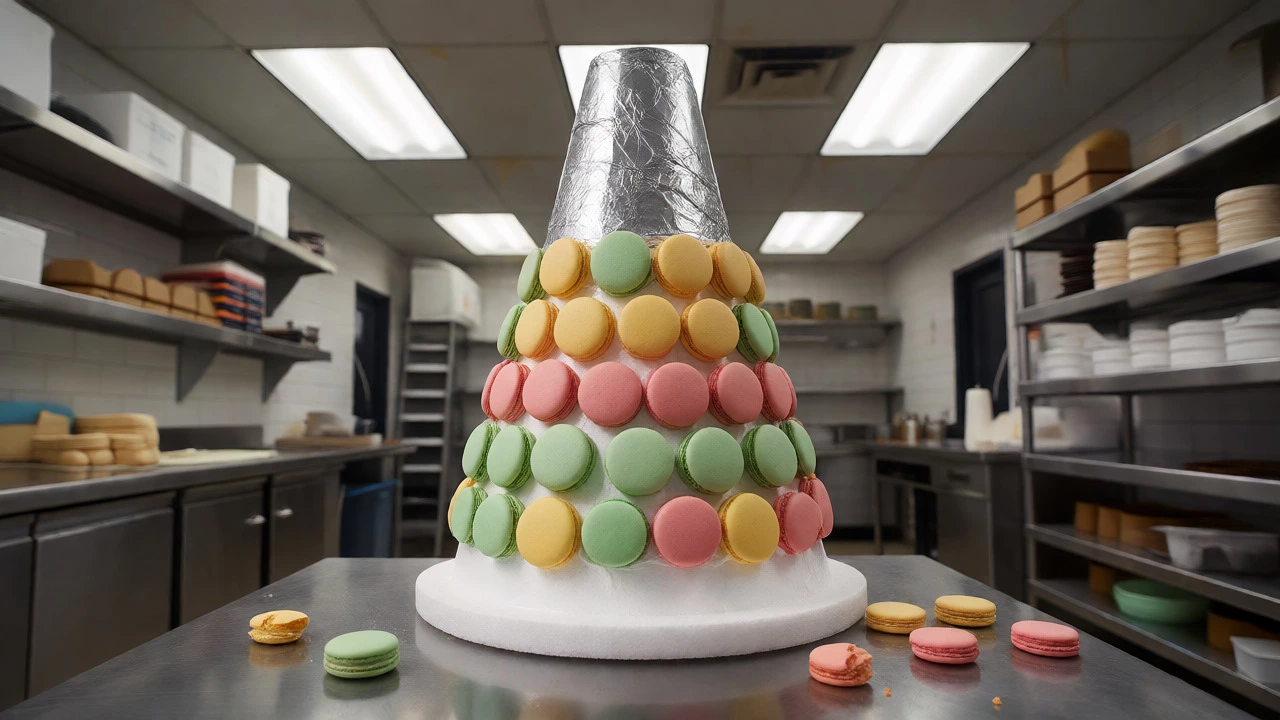
For a 10-tier tower using a hollow core (a styrofoam cone covered in foil or fondant), you are essentially covering the surface area rather than filling the volume. You calculate the surface area of the cone and divide by the footprint of a macaron, adjusting for overlap. Since macarons overlap slightly to hide gaps, you lose about 15% coverage efficiency to aesthetics. This drops the count significantly to around 250 macarons. This is the sweet spot for most clients who want the "wow" factor without the "bankruptcy" factor.
The Breakage Buffer
Here is a fact nobody tells you: macarons are fragile. Almond meringue cracks if you breathe on it wrong. During assembly, especially when stacking ten levels high, you will break some. I usually plan for a 10-15% breakage rate. If your math says you need 250 macarons, bake 290. If you bake exactly 250, you will end up holding two cracked halves together with royal icing while sweating profusely.
Consider the logistics of transport. A 10-tier tower is tall and top-heavy. Vibrations from a car ride can cause micro-fractures. If you use a single central rod (like a dowel through the middle), you reduce movement, but you increase the risk of shattering the entire column if it tips. Using individual tier stands reduces breakage but increases the visual gap between layers, which might require more decorative elements (like chocolate shards or flowers) to fill the voids, indirectly affecting the "clean" look of the macaron count.
Structural Integrity Matters More Than Count
Before you start piping batter, ask yourself: how will this stay up? A 10-tier tower is essentially a Jenga game made of sugar. If you go with the solid method, the weight distribution is key. The bottom macarons must be baked until crisp enough to bear load. Soft, chewy macarons will compress and cause the tower to lean or collapse within hours.
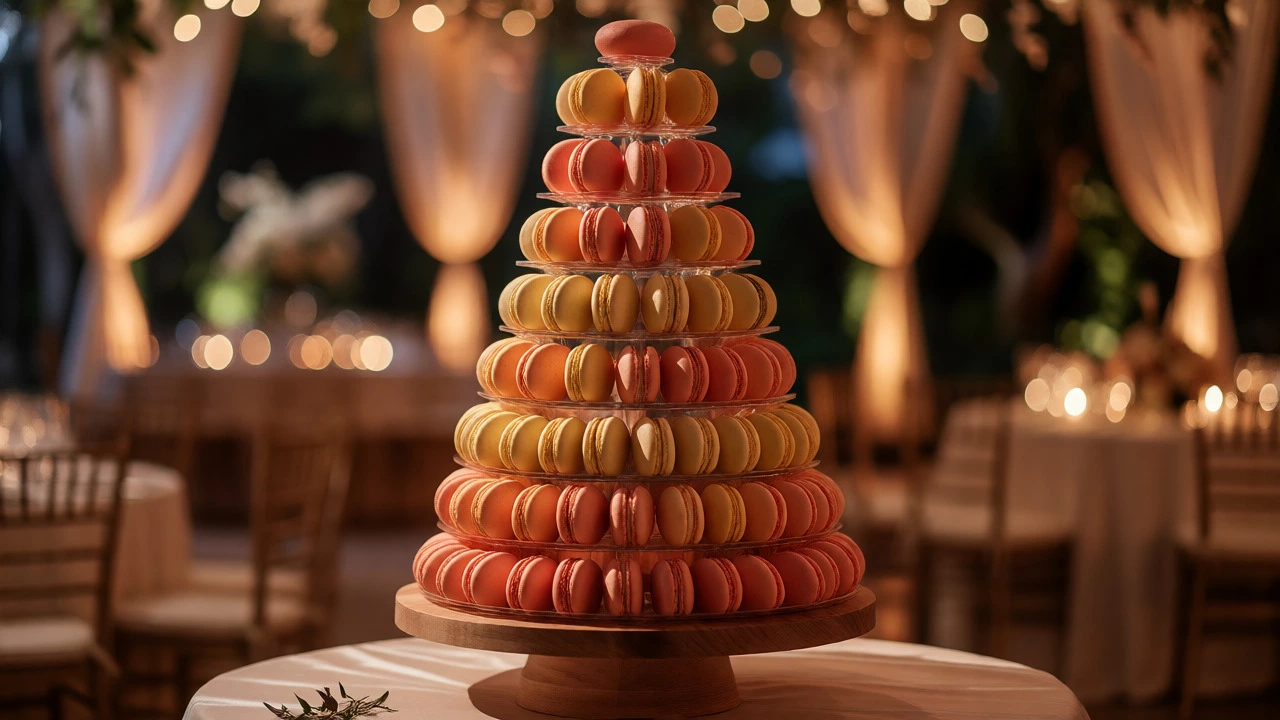
For hollow cores, you need adhesive. Royal icing is the standard glue. It dries hard and provides structural bonds between shells. However, too much icing adds weight and mess. Too little, and the tower slides apart. The relationship between royal icing and macaron shells is critical: the icing acts as both mortar and anchor. Ensure your royal icing is stiff-peaked consistency. Runny icing will seep out and ruin the aesthetic, requiring you to replace stained macarons, thus increasing your final count.
Practical Tips for Accurate Estimation
If you are building this for a real event, do not rely solely on formulas. Do a dry run. Buy a cheap styrofoam cone of the correct height. Lay out your macarons (or even cookies of similar size) on a flat surface to see how many fit in a circle of the base diameter. Multiply that by the average number of rows going up. This physical test accounts for the specific size of your macarons better than any generic formula.
- Measure Your Shells: Are yours 3.5 cm or 4.5 cm? A 1 cm difference in diameter changes the count by dozens.
- Check the Filling Thickness: Thicker ganache makes the macaron taller, reducing the number of vertical rows you can fit in a fixed height.
- Account for Decorations: If you plan to weave fresh flowers or gold leaf between layers, you might skip 10-20 macarons to create breathing room.
Remember, the goal is a balanced visual. A tower with 250 perfectly uniform macarons looks more expensive than one with 400 mismatched, cracked ones. Quality control beats quantity every time. If you find yourself short, use edible glitter or smaller mini-macarons to fill gaps rather than forcing full-sized shells into tight spaces.
Cost Implications of the Count
Why does the exact number matter? Money. One batch of macaron batter yields about 40-50 shells depending on pipe size. Almond flour prices fluctuate, but let’s say $15-$20 per batch including ingredients and labor. Baking 250 macarons means 5-6 batches. Baking 450 means 9-10 batches. That is double the oven time, double the cooling racks, and double the risk of failure due to humidity fluctuations in the kitchen.
For a baker in Auckland, where humidity can spike unexpectedly, scaling up production increases risk. It is often smarter to build a hollow-core tower (250 count) and invest the saved resources in higher-quality flavorings or better packaging. Clients pay for the presentation, not the caloric density. They won’t know there is foam inside unless they dig in with a spoon-and even then, they might prefer the ease of serving individual pieces from a tiered stand.
How long does it take to assemble a 10-tier macaron tower?
Assembly typically takes 2-4 hours for an experienced baker. This includes gluing each shell individually onto the core or stand. Rushing leads to instability and visible gaps. Allow extra time for drying the royal icing between sections.
Can I freeze a pre-assembled macaron tower?
Yes, but it is risky. Freezing assembled towers can cause condensation issues upon thawing, making the shells soggy. It is better to freeze the macarons separately in airtight containers and assemble them fresh on the day of the event. If you must freeze the whole tower, wrap it tightly in plastic wrap and foil to prevent freezer burn and odor absorption.
What is the best adhesive for macaron towers?
Royal icing is the industry standard because it dries hard and clear. Chocolate ganache can also be used but remains soft, which may cause slippage in tall structures. Avoid buttercream as it is too soft and greasy for structural bonding.
Do I need a special stand for a 10-tier tower?
A sturdy base is essential. For a hollow core, a weighted wooden or metal plate prevents tipping. For tiered stands, ensure each level has a non-slip mat or ring to keep macarons from sliding off during transport. Check the weight capacity of the stand before loading it.
How far in advance can I bake the macarons?
Macarons improve in texture after 24-48 hours in the fridge. Bake them 2-3 days in advance, store them in airtight containers in the refrigerator, and bring them to room temperature 2 hours before assembly. This allows the shells to mature and become easier to handle.





Write a comment